Bookkeeping
Accounting
Taxes
First-Time VPB Return: What Does the Tax Authority Expect From You?
Filing your first VPB return in the Netherlands? Learn how Dutch corporate tax works, avoid belastingrente, claim deductions correctly, and file your first corporate tax return with confidence.
•
16 mins
Intro
Starting a Dutch BV comes with a long list of administrative responsibilities. Most founders quickly become familiar with VAT returns, payroll obligations, and annual accounts. Then the first VPB return arrives. For many entrepreneurs, this is the first moment they discover that the profit shown in their bookkeeping software is not necessarily the profit the Belastingdienst wants to tax.
The first corporate income tax return is different from every one that follows. There is no previous filing to compare against, no historical provisional assessment, and often no established process for calculating fiscal adjustments. Founders frequently assume that once the annual accounts are finished, the VPB return is simply a formality. In reality, the annual accounts are only the starting point. Understanding the relationship between accounting profit, taxable profit, deductions, and filing deadlines is what determines whether the return is accurate, tax-efficient, and filed on time.
Why the First VPB Return Is Different From Every One That Follows
The first VPB return is structurally different from future years in several important ways. Established BVs have previous returns, prior assessments, and historical tax positions to use as a reference point. A newly incorporated company has none of these. Every assumption must be made from scratch, and every accounting decision creates a foundation for future years.
Many founders discover halfway through the process that the profit figure shown in their bookkeeping software is not the figure used for corporate tax purposes. The commercial profit reported in the annual accounts is only the starting point. Fiscal adjustments must be applied before the VPB rate is calculated. The DGA salary is often the most significant adjustment because it reduces taxable profit, but only if it has been processed correctly through payroll.
The first return also establishes how the company handles depreciation, investment deductions, mixed-use costs, and other recurring tax positions. Getting these right from the beginning avoids corrections later and creates consistency across future returns.
For most small Dutch BVs with straightforward operations, a single DGA, and no complex international structures, the first VPB return is entirely manageable once the underlying concepts become clear. Understanding the broader tax picture also helps. If you are still building your understanding of Dutch business taxation, it is worth reading how much tax you pay. Many founders who are just starting a company in the Netherlands encounter VPB for the first time only after their first financial year closes.
What VPB Is and Who Must File
Vennootschapsbelasting, usually abbreviated as VPB, is the Dutch corporate income tax. It is paid by the BV itself rather than by the shareholder or DGA personally.
Unlike income tax, which applies to salary and dividend income received by individuals, VPB applies to the taxable profit generated by the company. Every Dutch BV becomes subject to VPB from the moment it is incorporated, regardless of whether it makes a profit.
That means:
Profitable BVs must file and pay VPB.
Loss-making BVs must still file.
Dormant BVs generally retain filing obligations.
Other legal entities such as NVs, cooperatives, and certain commercial foundations can also be subject to VPB.
For 2026, the VPB rates are:
Taxable Profit | VPB Rate |
Up to €200,000 | 19% |
Above €200,000 | 25.8% |
The critical detail is that taxable profit is not the same as revenue, turnover, or even accounting profit. It is the final figure after all fiscal adjustments, deductions, and corrections have been applied.
A BV with zero taxable profit pays no VPB but still files a return. A BV that makes a loss generally pays no VPB and may carry losses forward to offset future profits.
The First Critical Concept: Commercial Profit vs Taxable Profit
This is the concept that causes more confusion than any other aspect of a first VPB return.
Your annual accounts are based on commercial profit. That profit reflects revenue and expenses recorded in your bookkeeping system. The VPB return, however, requires taxable profit, also known as fiscal profit.
The fiscal calculation starts with commercial profit and then applies a series of tax adjustments.
If you already have a balance sheet Netherlands prepared for your annual accounts, remember that the tax return still requires an additional layer of fiscal analysis.
Item | Effect on taxable profit | Common first-timer trap |
DGA salary (gebruikelijk loon) | Deductible, reduces taxable profit | Only deductible if processed correctly through payroll |
Depreciation | Fiscal rules may differ from accounting rules | Incorrect depreciation period on first-year assets |
Non-deductible mixed costs | Partially non-deductible | Meals and entertainment often treated as fully deductible |
WKR corrections | May increase taxable profit | Failure to settle excess WKR at year-end |
Deelnemingsvrijstelling | Removes qualifying participation income | Forgotten exemption in holding structures |
KIA investment deduction | Reduces taxable profit | Deduction not claimed despite qualifying investments |
Innovatiebox | Reduces effective tax rate to 9% | S&O declaration requirements overlooked |
This fiscal reconciliation is the primary reason many founders work with an accountant or bookkeeper. Overpaying VPB ties up unnecessary cash inside the tax system. Underpaying creates corrections, interest charges, and administrative complications later.
The First Boekjaar Problem: Short Years and Broken Periods
Many newly incorporated BVs do not have a full 12-month first financial year.
Consider a BV incorporated on 1 September 2025 with a year-end of 31 December 2025. Its first boekjaar lasts only four months.
This creates several practical consequences.
First, the filing deadline does not become shorter or longer because the financial year is shorter. The return is still due within five months after the end of the boekjaar.
Second, the VPB brackets are not prorated. If that four-month BV earns €80,000 profit, the entire amount remains within the 19% bracket. The €200,000 threshold applies per financial year, not per calendar month.
Third, depreciation calculations become more important. A laptop purchased in September does not generate a full year of depreciation in the first financial year. The calculation must reflect the actual period of ownership during that boekjaar.
Founders often overlook this because bookkeeping software frequently assumes standard annual depreciation schedules. Before filing, verify that depreciation reflects the actual acquisition date and ownership period.
Deadlines, Extensions, and What Happens If You Miss Them
Deadlines are relatively straightforward, but missing them can become expensive surprisingly quickly.
Situation | Standard deadline |
Calendar year boekjaar (1 Jan to 31 Dec) | 31 May |
Broken boekjaar | 5 months after year-end |
Short first boekjaar | 5 months after year-end |
Approved extension | As stated in approval |
Becon extension via advisor | Usually until 1 May following year |
A BV with a calendar year ending on 31 December 2025 must generally file by 31 May 2026.
If you cannot file on time, request an extension before the deadline expires. Extensions can be requested through Mijn Belastingdienst Zakelijk, and tax advisors often obtain longer extensions through the Becon system.
Missing the deadline without an approved extension typically results in:
A verzuimboete of approximately €385 for a first offence.
Increasing penalties for repeated late filing.
Additional scrutiny from the Belastingdienst.
There is also another cost that many first-time founders overlook: belastingrente.
The current rate is 8% annually and starts accruing six months after year-end. For a BV with a 31 December year-end, interest starts running from 1 July.
This is one reason why founders should not only think about filing deadlines. They should also think about payment timing. Just as recurring obligations such as when to file VAT require planning, VPB liabilities should be anticipated well before the final assessment arrives.
The Voorlopige Aanslag: What First-Timers Need to Know
Established companies often receive a voorlopige aanslag at the start of the year. This provisional assessment is based on prior tax history and allows the BV to pay tax in instalments throughout the year.
First-year BVs do not receive one automatically.
That creates two important consequences.
The first is a cash flow issue.
Without a provisional assessment, the company may make no VPB payments at all during the year. The entire liability accumulates and only becomes payable once the final assessment arrives.
A profitable BV can therefore face a large unexpected tax bill.
The second consequence is interest exposure.
If no provisional payments are made and the final return is filed late, belastingrente continues to accumulate on the unpaid balance.
A practical solution is to request a voorlopige aanslag yourself.
After the first quarter or two of trading, many founders have enough information to estimate annual profit. Submitting a reasonable estimate allows the Belastingdienst to spread tax payments throughout the year and significantly reduces both cash flow pressure and interest costs.
How to Actually File: eHerkenning, Software, and the Filing Process
Every VPB return must be submitted digitally.
There are two primary filing routes available.
Route 1: Mijn Belastingdienst Zakelijk
This is the official government filing portal.
To use it, you need:
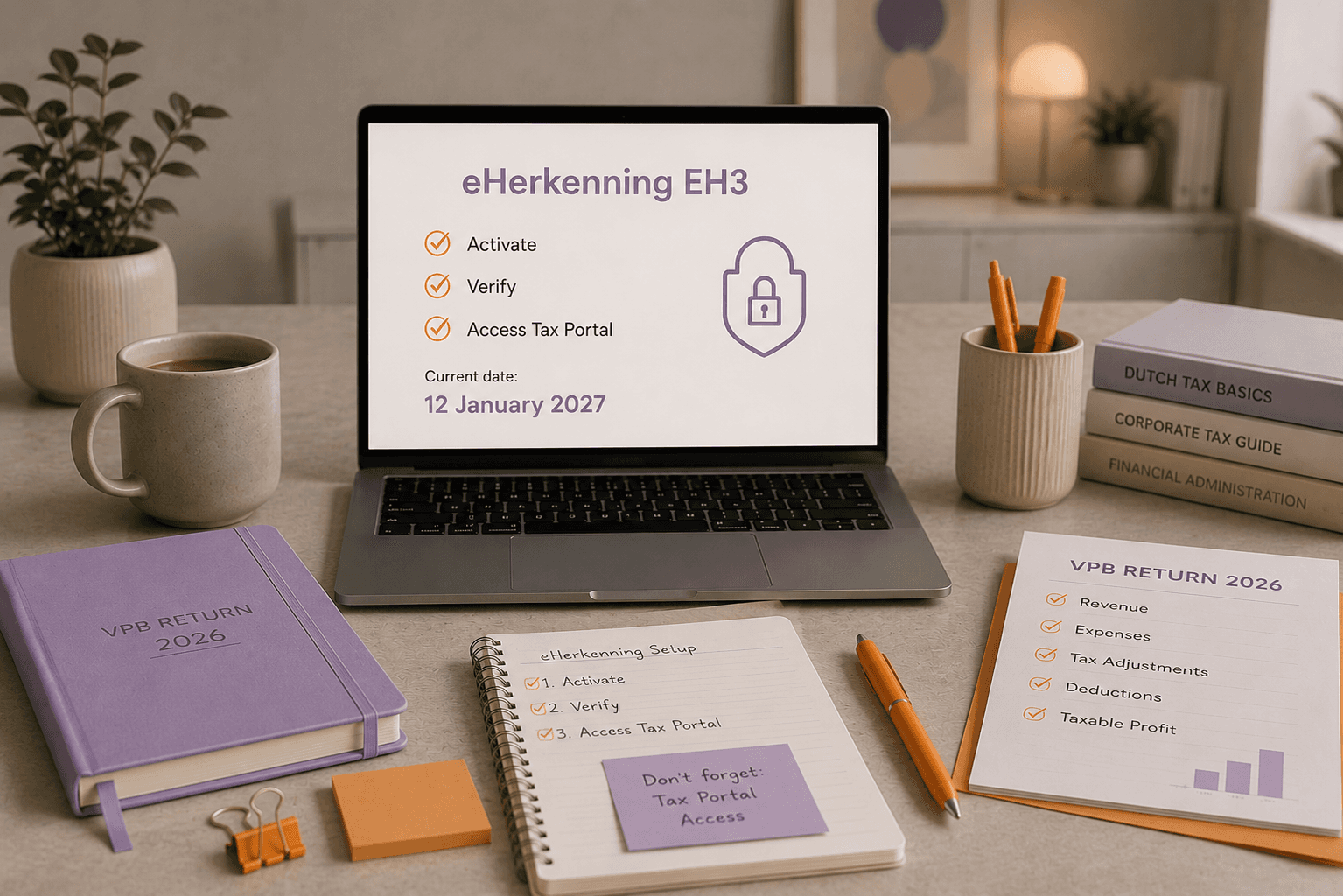
eHerkenning level EH3
Authorization for VPB filing
Access to your BV's fiscal information
Many first-time founders are surprised to discover that DigiD is not sufficient. eHerkenning is the business equivalent and must be obtained separately.
The application process typically takes:
5 to 10 working days
Around €25 to €75 annually
Verification through a certified provider such as KPN or Digidentity
Route 2: Tax Software
Most accountants and tax advisors use certified software connected through Standard Business Reporting (SBR).
Examples include:
Nextens
AFAS Profit
Fiscaal-online
Other recognized VPB platforms
Regardless of the filing method, the return requires:
A fiscal balance sheet
A fiscal profit and loss statement
A successful capital comparison (kapitaalsvergelijking)
If the balance sheet and profit calculations do not reconcile correctly, the filing may be rejected.
Key Deductions and Reliefs to Claim in Your First VPB Return
The VPB return is not just about reporting profit. It is also where legitimate deductions are claimed.
Many first-time founders focus exclusively on compliance and overlook opportunities to reduce their tax bill.
Before filing, verify the following:
1. DGA salary has been processed correctly
The minimum customary salary for 2026 is €58,000.
Confirm that:
Payroll has been run correctly.
Wage tax filings have been submitted.
Salary is booked as a business expense.
This topic becomes even more important when evaluating DGA salary vs dividend.
2. Business expenses are complete
Review software subscriptions, professional training, travel expenses, advisory costs, and other operational expenditures.
3. KIA investment deduction
The Kleinschaligheidsinvesteringsaftrek can significantly reduce taxable profit.
For 2026:
Investments must generally exceed €450 per asset.
Total qualifying investments between €2,901 and €392,230 may qualify.
The deduction can reach up to 28%.
4. Innovatiebox eligibility
Innovative companies holding an S&O declaration may qualify for the innovatiebox regime, reducing the effective VPB rate on qualifying profits to 9%.
5. Loss carry-forward
Losses generated during the first financial year are not wasted.
They can generally be:
Carried back one year
Carried forward up to nine years
6. Deelnemingsvrijstelling
Holding structures may benefit from participation exemption rules that exclude qualifying dividends and capital gains from taxable profit.
What the Belastingdienst Checks and When You Might Hear Back
After filing, the Belastingdienst reviews the return and issues a definitive assessment.
For straightforward returns, this often happens within three to six months.
The tax authority generally has three years from the filing date to review and amend a return. That period may be extended where filing extensions were granted.
Additional scrutiny becomes more likely when:
DGA salary appears unusually low
Deductions seem disproportionate to turnover
Payroll filings do not match the VPB return
The final return differs substantially from provisional estimates
The Belastingdienst can also conduct a bookkeeping audit, known as a boekenonderzoek.
Although first-year BVs are not the primary audit target, audits can occur. Supporting documentation must therefore be retained for at least seven years, and ten years for certain real-estate related records.
A well-prepared return supported by accurate bookkeeping, reasonable deductions, and consistent reporting is unlikely to attract significant attention.
Your First VPB Return. And Every One After It.
The first VPB return is rarely difficult because of complexity. It becomes difficult because founders encounter unfamiliar concepts all at once. Commercial profit versus taxable profit, provisional assessments, belastingrente, eHerkenning, DGA payroll, depreciation rules, and investment deductions all converge in a single filing. Missing one element can result in unnecessary tax payments, penalties, or interest costs that continue into future years.
Neno was built specifically for Dutch BV founders who want their financial administration handled correctly from day one. Whether you want to incorporate your BV or streamline your ongoing bookkeeping and payroll, our certified accountants monitor your company throughout the year so that when the VPB deadline arrives, your figures are already reconciled and ready. No last-minute stress, no missed deductions, and no unpleasant surprises from the Belastingdienst.
FAQs: First-Time VPB Return in the Netherlands
When must I file my first VPB return?
The return must generally be filed within five months after the end of your financial year. A BV with a 31 December year-end typically files by 31 May.
What is the difference between commercial profit and taxable profit?
Commercial profit is the accounting profit shown in the annual accounts. Taxable profit is the adjusted figure used for VPB after applying fiscal corrections and deductions.
Do I need eHerkenning to file the VPB return?
Yes. Filing through Mijn Belastingdienst Zakelijk requires eHerkenning level EH3.
What happens if I miss the VPB deadline?
You may receive a verzuimboete and become liable for belastingrente on unpaid tax balances.
Can I request an extension for my VPB return?
Yes. Extensions can be requested before the original deadline through Mijn Belastingdienst Zakelijk or through a tax advisor.
What is belastingrente and when does it apply?
Belastingrente is interest charged on underpaid corporate income tax. For calendar-year BVs it generally starts accruing from 1 July after year-end.
What is a voorlopige aanslag and do I get one as a first-year BV?
A voorlopige aanslag is a provisional tax assessment. New BVs generally do not receive one automatically and must request it themselves.
What is the KIA and can I claim it in my first return?
Yes. The Kleinschaligheidsinvesteringsaftrek is available to qualifying investments and can significantly reduce taxable profit.
What does the Belastingdienst do after I file?
The tax authority reviews the return and issues a definitive assessment. Straightforward returns are often processed within three to six months.
Can I file the VPB return myself without an accountant?
Yes. Many founders file independently. However, because fiscal corrections are often more complex than expected, many BVs choose professional support to avoid costly mistakes.

Written by
Nick Knuppe
CEO & Founder